



Include work life visits in study units
How are work life visits implemented?
The Duuniskooppi website connects educators and employer representatives by offering a guided path and resources for implementing on-site or online work life visits for upper secondary school students. Get to know local organisations using the search function and select a workplace suitable for your study unit.
Work life visits aim to help young people make career choices based on their interests and strengths and to connect the studied subject to working life. This helps upper secondary school students in future career choices by expanding their knowledge of jobs.
Educator and employer representative roles
Educators (subject teachers and guidance counsellors)
- Find an appropriate workplace to visit
- Contact the organisation and agree on a time
- Review the Educator resources
- Use the resources to prepare for the visit
- Implements the visit during the study unit (online or on-site)
Employer representatives
- Review the employer representative resources before the visit
- Use the resources to prepare for the visit
- Prepare a presentation to support the visit
- Implements the visit for an upper secondary school study unit (remote or on-site)
Required temporal resources
The visit path and resources have been prepared in cooperation with subject teachers, study counsellors and employer representatives. Temporal constraints have been factored in the plan.
Schedule
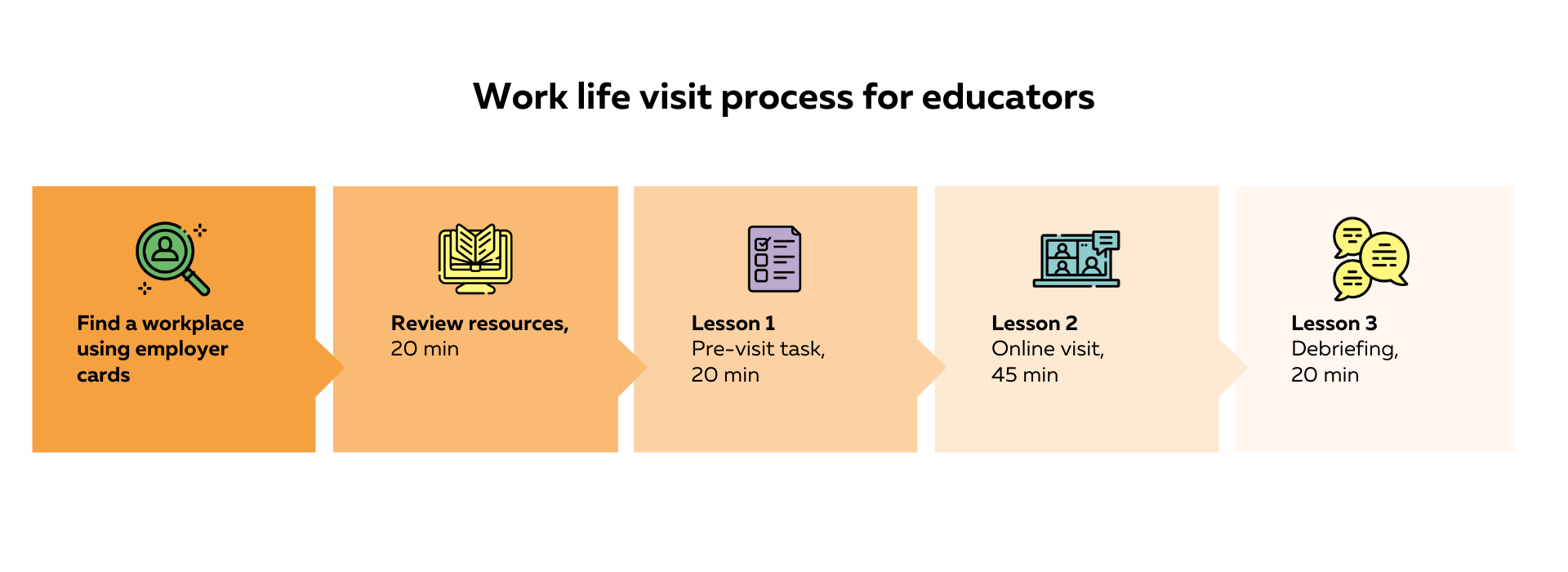
- Educator resource review approx. 20 min
- Pre-visit preparations in class approx. 20 min
- Work life visit during one lesson: minimum visit duration 45 min, post-visit summary discussion at the end of the lesson
How to get started
- If you want to arrange a visit for your students, use the search engine to find a site and contact an employer representative. Suggest a few suitable timeslots and describe your course content.
- Review the resources to create a pedagogical work life visit path for students.
Resources
Our resources include help for student orientation, instructions for implementation of a visit as part of a study unit and support for visit debriefing. The resources include current information on how young people feel about employment and education, which helps in preparing a work life visit from their perspective.
Palvelu aineenopettajille ja opinto-ohjaajille
Duuniskooppi – työelämävierailumalli koostuu kolmesta vaiheesta: valmistautuminen nuorten kanssa, vierailun toteutus ja keskustelu nuorten kanssa jälkikäteen. Voit toteuttaa vierailun jakamalla sen eri päiville / viikoille tai valita projektiluontoisen toteutustavan esimerkiksi päättöviikolla yhden iltapäivän aikana. Työelämävierailujen tavoitteena on tukea nuoria omien kiinnostusten ja vahvuuksien mukaisissa valinnoissa, auttaa heitä löytämään merkitys opiskeltavan aineen ja työelämän välillä sekä tukea opetushenkilöstöä opetussuunnitelman mukaisten tavoitteiden saavuttamisessa.
Tarvittavat aikaresurssit
Aika herättää paljon keskustelua – mutta ei huolta. Me duuniskooppilaiset olemme laatineet sekä vierailuprosessin että perehdytysmateriaalit yhteistyössä aineenopettajien ja opinto-ohjaajien kanssa aikaresurssit mielessä pitäen. Tässä näet yleiset raamit ajankäytölle:
Opetushenkilöstön oman perehdytysmateriaalin läpikäyminen: n. 20 minuuttia
Valmistautuminen nuorten kanssa: n. 20 minuuttia oppitunnistasi
Vierailu: 45 minuuttia (lähivierailun pidentämisestä voi neuvotella työelämäedustajan kanssa)
Vierailusta keskustelu nuorten kanssa: n. 20 minuuttia oppitunnistasi
Näin pääset mukaan
Rekisteröidy käyttäjäksi. Käyttäjätunnuksesi saatuasi, pääset kirjautumaan perehdytysmateriaaliin, jonka avulla saat luotua pedagogisesti toimivan kokonaisuuden. Materiaali sisältää myös tarkemmat ohjeet yhteistyöhön työelämäedustajan kanssa. Myös me duuniskooppilaiset olemme tukenasi. Autamme luomaan yhteyden valitsemaasi vierailukohteeseen.
Yhteystiedot: duuniskooppi@lists.oulu.fi
Find a place to visit
University of Oulu
The primary task of the university is to provide research-based teaching.
University employees work in research, teaching and development. Our employees’ job descriptions may comprise several roles.
The teaching and education sector seeks to understand learning, growth and development of individuals and groups. Research contributes to a body of knowledge on a variety of topics including human development throughout the lifespan, the principles of learning, and interaction. Teaching and research in the field of Education are multidimensional, combining psychology, arts, and culture and society.
Understanding people is imperative in a changing society.
Many changes and new developments in our society require an understanding of what it is to be human. Studying the impact of certain phenomena on humans, as well as our contribution to these phenomena, is important. These phenomena include for example digitalisation, changing work life, ageing population and climate change.
In the future, teaching and education professionals who are experts in learning, growth, and development, will be in high demand. Our work community includes a variety of experts working on different topics. Together we are strong and can create a better future by educating teachers of the future.
Equity and equality are considered in our work environment, research, studies and teaching. Ethical and legal considerations guide our activities in all human interactions.
University Teacher, University Lecturer, PhD Researcher, Project Manager, Research Assistant, Professor, Researcher, Planner, Rector, Dean, Executive Assistant, Communications Specialist, HR Specialist, IT Specialist